
HOME IMPROVEMENT · LEAD GENERATION
Home Improvement Lead Generation: How I Attract Customers for Window and Door Replacement
For window and door replacement, an enquiry should start with a homeowner who understands the offer, has a property in the service area and wants work the company actually does.
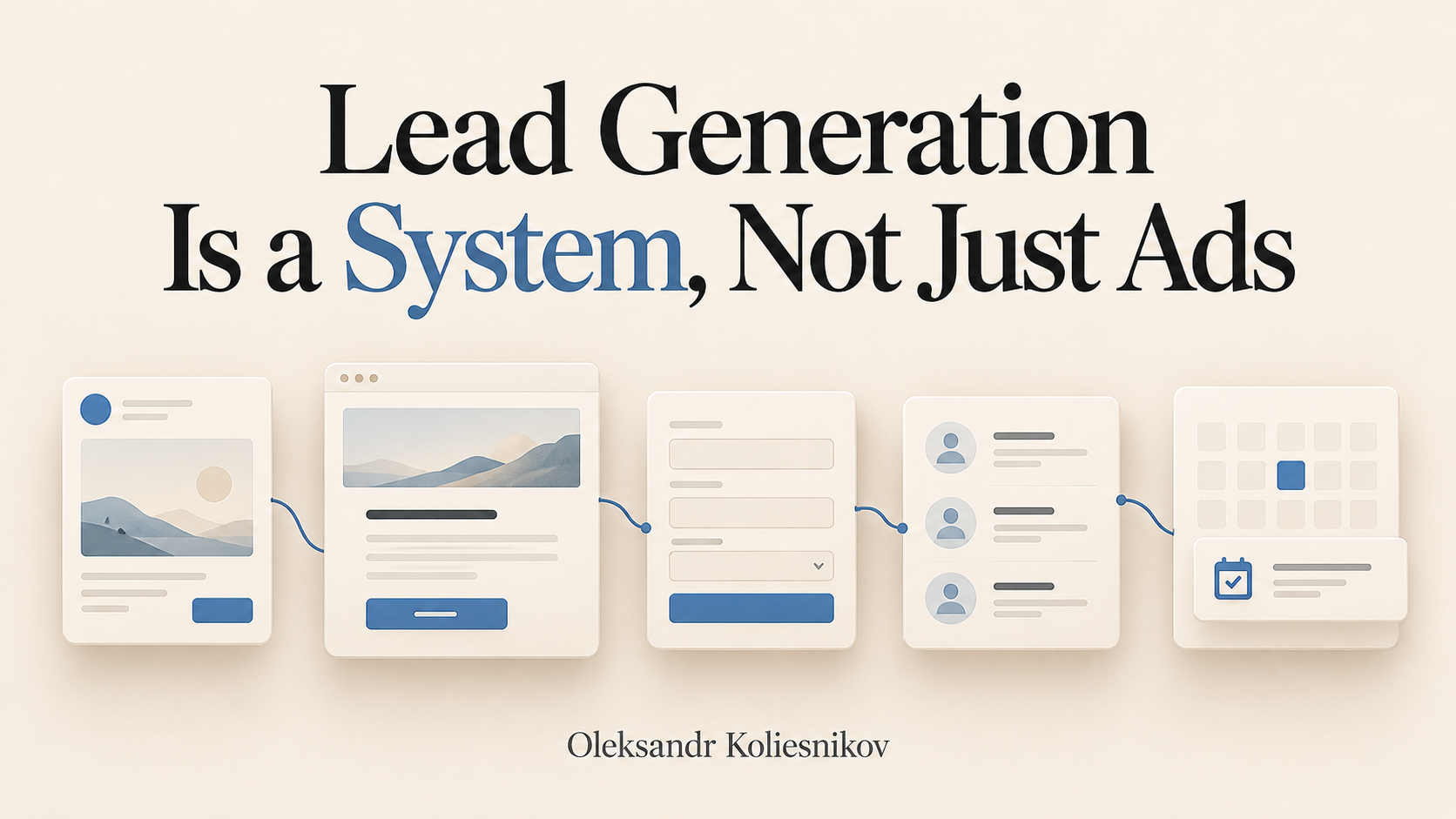
In home improvement, launching ads and collecting phone numbers is not enough. The aim is to reach someone who understands the offer, has a property in the service area and wants to discuss work the company actually does.
I work on lead generation for windows and doors. For me, this means more than targeting settings or managing social media. It takes product knowledge, an understanding of homeowners’ questions, and ongoing work on the ads, landing page and form. Advertising window replacement like any other product leaves a substantial part of the problem outside the ad account.
Below, I explain how I approach this work. The example wording illustrates campaign preparation, not the results of an individual client.
An interest in windows can mean very different jobs
Someone says they have a problem with a window. That does not necessarily mean they want to replace it.
They might need a sash adjusted, a sealed glass unit replaced, one new window installed or all the windows in their house replaced. Some people are buying for new construction. Others want products without installation.
These are different enquiries for the business. If a company offers window replacement with installation, an ad promising to “solve any window problem” attracts too broad a range of requests. A salesperson then has to explain that the service someone needs is not available.
Before launch, I would separate the offer at least by the actual work: repair, replacement, supply or installation. The advertising should promote the service the company genuinely wants to sell.
It also matters how customers describe their needs. A homeowner might say “window repair” while meaning a complete replacement. One word is not enough to disqualify the enquiry. But repeated requests for adjustments that the business does not offer are a reason to review what the ads are promising.
The same applies to doors. An entry door, an interior door and a patio door serve different needs. One attractive image and the general word “doors” do not explain what the contractor is offering.
The advertising offer needs to explain what the customer will get
Window advertising can easily become a list of familiar words: quality, energy efficiency, reliability and a good price. Those words do little to explain a specific offer.
A homeowner needs to understand at least a few things:
- Does the company sell products, or provide replacement with installation?
- Is the service suitable for their property?
- Where does the contractor work?
- Can they discuss a small replacement, or is there a minimum project size?
- What happens after they enquire?
I would start with those answers before choosing the wording for an ad.
For example, “Get a preliminary estimate for window replacement” describes a more specific action than “Learn more.” But it is appropriate only if the next step actually helps the customer obtain an estimate. If a staff member first needs to clarify the project, explain that.
Do not promise an instant price when it cannot be established without selecting the products and assessing the work. And do not replace a clear offer with a discount whose conditions are revealed only during a conversation.
An ad sets expectations before the first call. If it attracts someone with one promise and the company then offers something else, an enquiry-quality problem is a predictable result.
The product in the image also qualifies the future enquiry
Working in home improvement requires understanding what the ad actually shows. A photograph of a window is not suitable simply because it looks expensive and attractive.
Check the construction, opening mechanism, appearance and installation context. A product familiar in one market cannot automatically be carried over to another. Review the particular company’s range, rather than assumptions about what windows “usually look like” in a country.
If an ad shows a product the contractor does not supply, a customer may enquire specifically about that product. Technically, the ad worked: someone noticed the image and left their details. For the business, it created an enquiry based on the wrong expectation.
That is why real products and completed work that the company has permission to show are useful for creative assets. The image should help a homeowner recognize their own project: replacing windows in a house, installing a new entry door or choosing a particular configuration.
There is no need to put the entire catalogue in one ad. Make the specific offer understandable. The differences between options can be explained later, once the person is interested in the service.
After the click, continue the conversation about replacement
Someone arriving from an ad for window replacement should not have to work through a general catalogue of every service.
The page needs to answer the questions that brought them there: which windows can be replaced, how the work is carried out, what affects the estimate, where the company operates and how to discuss their project.
For this kind of advertising landing page, I prefer one main purpose. If the campaign promotes replacement, the page is about replacement. Selling products without installation is a different offer. Do not combine them in a way that leaves the customer to work out what the price includes and what they are ordering.
That does not mean leaving the page without explanations. A homeowner may care about removal of the old windows, protection of the room, finishing after installation and warranty terms. Publish the company’s actual conditions: who is responsible for what and what the work includes.
Answers to questions that repeatedly come up in customer conversations are particularly useful. If people keep asking whether installation is included, make that information more visible before the enquiry.
Page length is not the main issue. The person needs enough context to make an informed enquiry, without encountering a different offer after the click.
The form should help describe the project, not test technical knowledge
For window replacement, it helps to understand the intended work in advance. But a homeowner should not have to know installation dimensions, profile names or professional terminology.
Simple early questions might include:
- What needs replacing: windows, doors or both?
- Roughly how much work are they considering?
- Which city or neighbourhood is the property in?
- When are they planning the project?
- How would they prefer to be contacted?
This is a possible set of questions, not a mandatory questionnaire for every company. If an answer does not help assess the enquiry or prepare for a conversation, consider whether the question is needed at this stage.
“I’m not sure yet” can be more useful than requiring an exact answer. Someone may be ready to discuss replacement without having counted every window or decided whether to do the whole house at once.
Likewise, “Get an estimate” should not turn into an unexpected invitation to book a measurement visit. Explain the next step: first clarify the task, then agree on the subsequent process if the project is suitable.
A good form helps start a focused conversation. It does not replace a consultation and should not exclude someone merely because they have not yet become a window specialist.
Why I compare Facebook forms and landing pages by the actual enquiries
In my experience, built-in Facebook forms generated more enquiries at a lower cost. However, those enquiries more often included people who said they had not submitted a form or could not remember doing so.
On a landing page with thoughtful product information and an enquiry form, the enquiries were more considered. A contact could cost more, but the person better understood the service being discussed.
This is my experience, not a rule that built-in forms are always bad. What matters is what happens in the particular campaign.
For a window company, a useful comparison is how many people from each source:
- Confirmed an interest in replacement.
- Had a property in the service area.
- Were looking for a suitable service.
- Reached a substantive discussion of the project and a subsequent estimate.
If the only measure is the cost of a phone number, some of the work of explaining the offer simply moves to the salesperson. The report shows a cheap lead while an employee spends time talking to someone who expected something quite different.
At the same time, a more expensive enquiry cannot be declared high quality in advance. That needs to be checked against the actual enquiries and what happens next.
Geography needs to match the location of the work
For window replacement, the property’s address matters more than someone’s interest in a city or region.
In Canadian campaigns, I pay attention to exclusions as well as the areas included. This helps limit impressions in places where the company does not want enquiries. The available settings need to be checked for the particular platform and campaign.
Even careful targeting does not remove the need to check actual enquiries. Someone may be in one place while looking for a contractor for a house somewhere else. Asking where the property is located is more useful than assuming the advertising system has already determined it perfectly.
The offer itself should make the service area clear. If a contractor serves particular cities, “We work across Canada” creates the wrong expectations.
When enquiries arrive from distant areas, I would check several things together: campaign settings, the offer’s wording and the locations of the properties. Simply labelling them “bad leads” is not enough.
Refinement starts after launch
In windows and doors, I keep returning to the form and landing page. I launch a working version, observe how people respond and refine it. Leaving everything untouched after launch does not, for me, mean the lead-generation work is complete.
Specific observations suggest the next change.
If enquiries are about repair rather than replacement, review the ad’s promise and the service description. If people expect a price without installation while the company sells the complete job, explain the scope more clearly. If interested visitors stop at a technical question, it may have been asked too early or worded unclearly.
Behaviour on the page also helps identify problems. Heatmaps and session recordings in Microsoft Clarity help me examine which sections visitors reach and how they interact with page elements. Those observations should be compared with the enquiries, and data collection configured with privacy in mind.
I would not change all the copy, audience, images and form at the same time without a reason. It is more useful to choose a specific problem, make a clear change and check the enquiries that follow. Changing a page does not, by itself, prove an improvement.
What working lead generation means to me
In home improvement, an advertising campaign should lead to a conversation about real work. The customer understands the offer. The company understands the need. The property is in the right area, and expectations do not conflict with the contractor’s capabilities on the first call.
To achieve this, I connect product knowledge, the advertising offer, the page and the form, then return to the actual enquiries. That is where I can see what needs to be clarified, removed or explained better.
Advertising settings matter. But the quality of window and door lead generation also depends on how accurately the company helps a homeowner recognize their project, understand the offer and take the next step.
About the author
Oleksandr (Alex) Koliesnikov is a Toronto-based specialist in lead generation, Local SEO, and AI search visibility, including GEO and AEO. He works primarily with home improvement businesses and also helps companies implement CRM systems and business process automation.
Website: https://koliesnikov.com/